
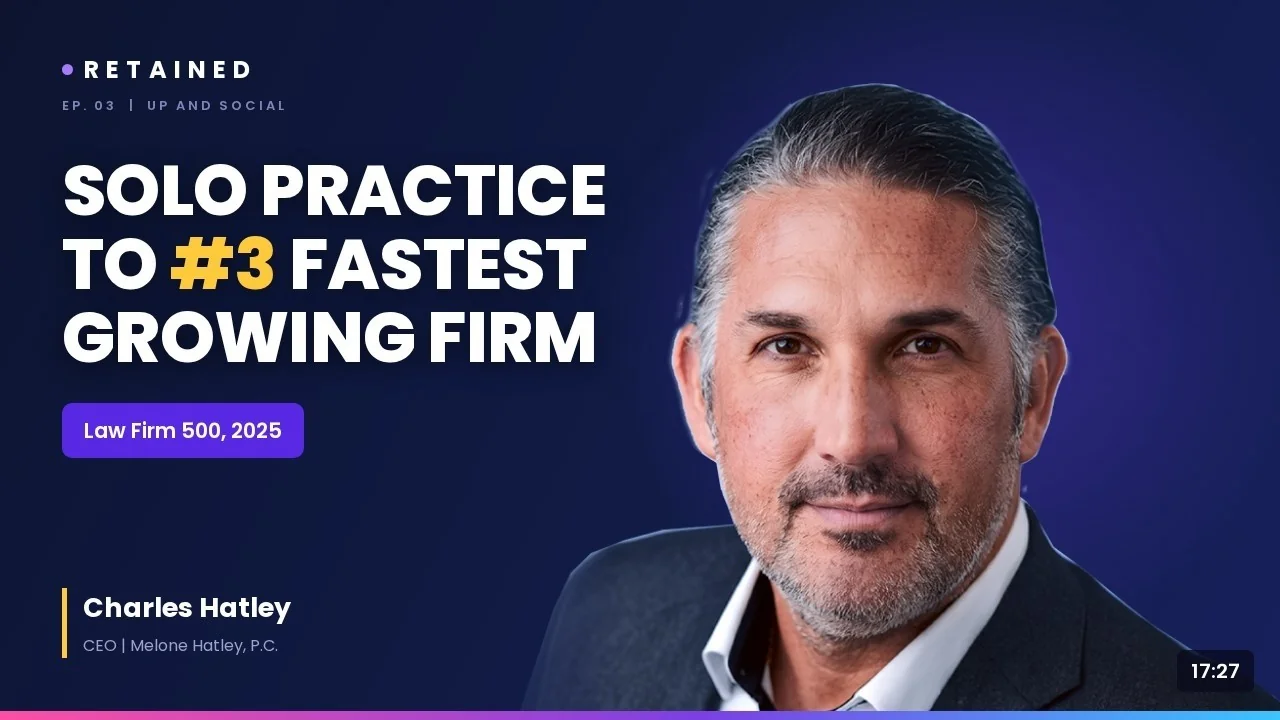
Episode 3
How a Solo Practice Became #3 on the Law Firm 500 | Charles Hatley
October 8, 2026 · 00:17:27
With Charles D. Hatley, CEO, Melone Hatley, P.C.
About the guest
Charles D. Hatley is the CEO of Melone Hatley, P.C., a family law and estate planning firm. His wife, Rebecca Melone, started it as a solo practice in Reston, Virginia, in 2014. Today it has offices in Virginia, South Carolina, Florida, and Texas.
Episode summary
What fast growth costs
Charles says growth burns cash. The first lesson was that profit and loss reports mean little if there is no cash in the bank. Growth also means waiting on good opportunities until other parts of the firm are ready. And as he moved up, he lost daily contact with people he used to talk to every day.
Running a firm with your spouse
Rebecca founded the firm and later suggested Charles become CEO while she became CFO. They make most decisions together. Their tiebreaker rule: if one of them feels strongly and the other is on the fence, the one on the fence goes along.
Marketing in-house, led by data
The firm brought almost all marketing in-house. Charles calls hiring a true data analyst the smartest early move. With good data, they could see where their best clients came from and put their budget there. He also noticed his own eyes went straight to the Google map, so the firm invested in showing up there. Later he asked an AI tool how to show up in its answers, and it laid out steps.
The one number: retains
Impressions, visits, clicks, and calls all matter less than one number: retains. He checks retains daily. Weekly, he checks cost per acquisition and marketing spend as a share of gross revenue.
A separate test budget
New ideas come from a test bucket held apart from the main budget. Each test needs a clear hypothesis and gets about three months. Tracking tools, like a separate phone number on a printed booklet, show what each dollar returns.
The AI brick wall
The marketing team uses AI for content calendars and planning. But Charles keeps AI away from client information. AI use stops before a person shares the facts of their situation. His view is that attorneys cannot yet explain the technology well enough to justify putting client data into it. The firm is building a closed internal system instead. It also follows European-level data privacy standards with help from a privacy consultant.
A case that stuck with him
Charles described a mother whose claims no one believed for years. A $500 forensic review of her home router showed the other side was accessing her network and cameras. The case turned, and the children got real help.
Advice for firm owners
Get out of production as fast as you can, then out of sales, meaning consultations. Learn each part of the firm: marketing, intake, sales, production, and finance. Do not overpay for help just because you think your time is worth more than it earns today.
Key takeaways for family law firms
- Watch cash in the bank, not just reports. Growth needs cash.
- Decide how you will break ties if you share leadership.
- Track where your best clients come from, and spend more there.
- Make retains your main metric. Add cost per acquisition and marketing spend as a share of revenue.
- Keep a separate test budget. Give each test a hypothesis, a time limit, and a way to track results.
- Decide where AI stops in your firm, especially around client facts. Check your state's ethics guidance.
- Work toward stepping out of daily casework and consultations so you can lead.
Notable quotes
"Growth burns cash."
"At the end of the day, the only thing that feeds our attorney's work to do are retains."
"But if nobody's paying you, your time's worth zero."
Chapters
- 0:00Welcome to Retained
- 0:49What fast growth really costs
- 2:05Running a firm with your spouse
- 3:30Marketing in-house and the map
- 6:16The one number: retains
- 6:56The marketing test budget
- 7:55The AI brick wall
- 10:32European-level privacy
- 11:38The router case
- 14:40Advice for growing firm owners
- 15:51What's next for Melone Hatley
Related episodes
This summary is for general information, not legal advice. Experiences shared are specific to the guest's practice and do not promise results for another firm.